

What is hydrotherapy?
Hydrotherapy or aquatherapy is part of almost every rehabilitation plan. It is a very effective method of animal rehabilitation that makes use of the physical properties of water. Dogs walk or run on a treadmill placed in a water chamber filled with water at the right temperature. The buoyancy of water allows the dog to move in such a way that significantly reduces the load on its joints. The dog also has to overcome the resistance of water, which strengthens its muscles.
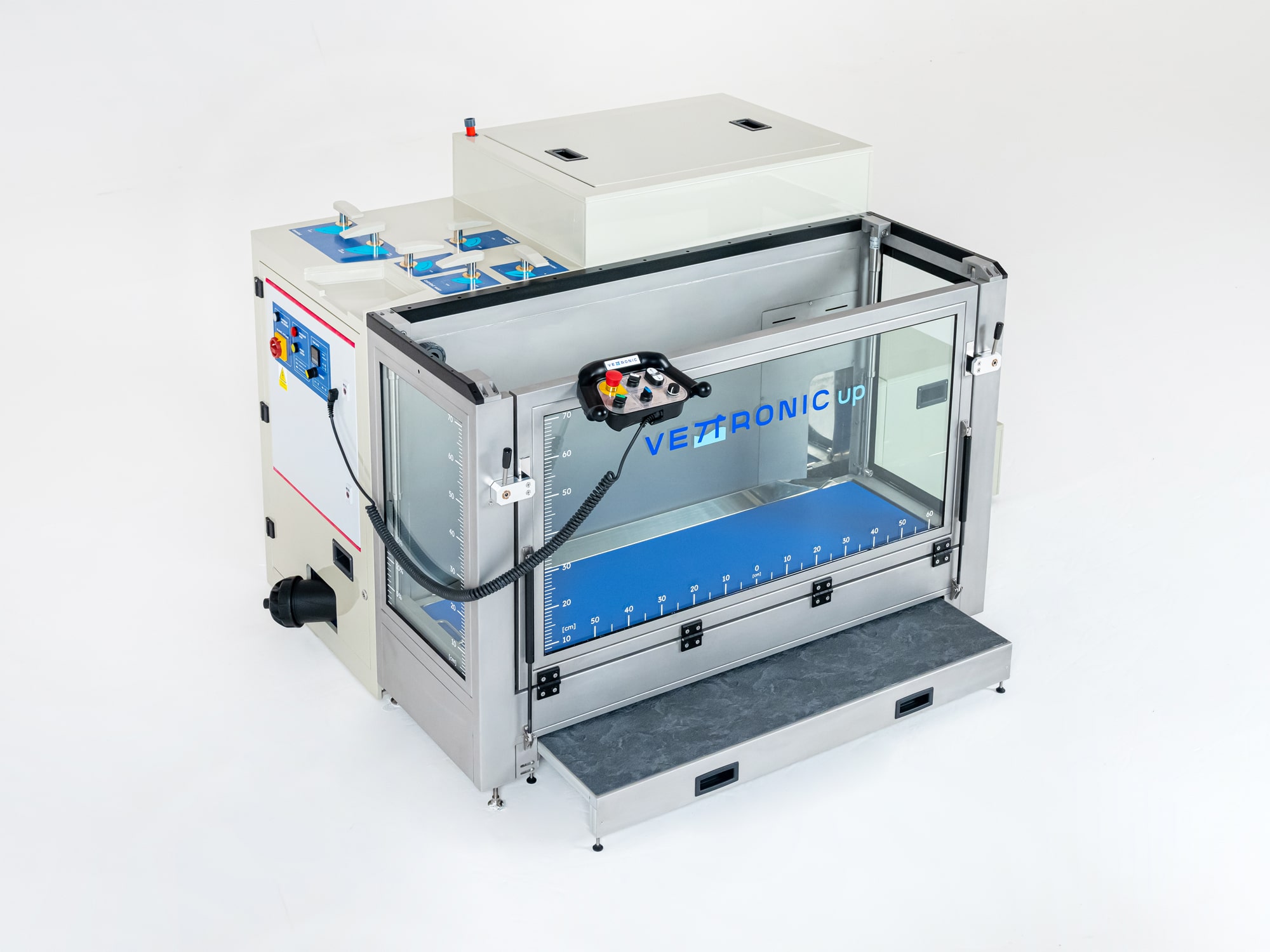
Principles of hydrotherapy
Water is an ideal environment for the rehabilitation of neurological or orthopaedic patients, but also, for example, for training sports dogs who are trying to get into shape. We use the physical properties of water to make it easier or more difficult for the patient to perform certain movements, both of which lead to a positive effect on the body. Here is a summary of how water and an underwater treadmill can benefit our patients.
Buoyancy
You might remember Archimedes’ principle from school: “Any object, totally or partially immersed in a fluid or liquid, is buoyed up by a force equal to the weight of the fluid displaced by the object.” This is very important in hydrotherapy, because buoyancy allows an immobile dog’s body weight to be supported, and relieves joints carrying too much load.
There is a study that indicates what percentage of a dog’s body weight is buoyed when the water level reaches a specific height (wrist, elbow, hip height).
Hydrostatic pressure
This phenomenon, defined by Blaise Pascal, states that the entire surface of an object submerged in water is subject to hydrostatic pressure proportional to the depth at which the object is located. This has a positive effect on microcirculation, enhances blood circulation in the tissue, reduces swelling and pain, and can help calm the patient. Pressure on the lungs positively affects the patient’s breathing capacity.
Viscosity
This is characterised as the friction of water molecules, which causes resistance to the patient’s movements. This is good in terms of muscle strengthening and leads to the reflex stimulation of spontaneous movements.
Turbulence
We also have turbulence, which is caused by the active movement of molecules. The more intense the movement in the water, the more turbulence it creates. Therefore, this phenomenon is also important in training and strengthening patients in the final phase of recovery, or for sports dogs.
Using a hydrotherapy underwater treadmill, we can increase the turbulence by using a resistance current. This can also be used to help patients finding it difficult to move, where we create a flow not against, but in the same direction the dog is moving.
For the resistance current to be maximally effective, we recommend using two jet nozzles that act evenly on both sides of the body. As a result, the dog does not tend to move out of the current’s way or lose balance, as can happen with a single jet nozzle.
Surface tension
At the water’s surface, the bonding force between its molecules is stronger and they maintain surface tension. If the dog has to take its limbs out of the water (above the surface) when moving, it is forced to overcome the surface tension and the movement is more physically challenging. This again makes the dog stronger. It has to use more energy compared to moving on dry land (to overcome the resistance of water and its surface tension).
The biomechanics are different: on dry land our muscles work against gravity, in water our muscles work against the water’s resistance. According to various studies, we spend four times the amount of energy it takes to run a certain distance when swimming the same distance.
Water temperature
We also have to think about water temperature. Depending on the size and condition of the patient and the intensity of the exercise, the ideal range of temperatures used on the underwater treadmill is 26 to 32 °C. Temperatures at the lower limit are used when training sports dogs, while temperatures between 30 and 32 °C are more suitable for paralysed dogs.
Warmer water works better for small dog breeds, while larger breeds require temperatures at the lower end of the ideal range.
Note that at higher temperatures, it may be easier to overheat and exhaust the body. At a lower temperature, on the other hand, the energy in the muscle is depleted more quickly. Muscle contractions are imperfect and muscle tremors will start at water temperatures below 20 °C. Movement in water of around 24 – 26 °C is more energetically demanding in terms of maintaining core temperature, and can be used for weight reduction with regular training.
Treadmill speed
We must not forget that the speed of the treadmill can also have a major impact on rehabilitation and needs to be set individually. Lower speeds are appropriate for dogs with severe health deficits, allowing the therapist to focus on optimally distributing the dog’s weight onto the affected limb. In advanced rehabilitation or conditioning training, the speed should be adjusted so that the dog moves at a regular pace. If the speed is too low, the dog’s movements are not smooth and the therapy becomes less effective.
Treadmill incline
The treadmill incline is another aspect that can be useful in hydrotherapy. The presumption is that, if the dog is walking uphill, it is working harder. But that is not quite true – the benefits of the treadmill incline lie elsewhere.
Since the dog remains in one place on the treadmill, it is the belt that is moving under its feet. The dog is not required to push against gravity, as would be the case if it was really walking uphill. The treadmill incline effectively changes the biomechanics of the dog’s movement. The centre of gravity is shifted slightly backwards, i.e. the dog engages its hind legs more. At the same time, the range of motion in the joints increases. We consider this to be beneficial.
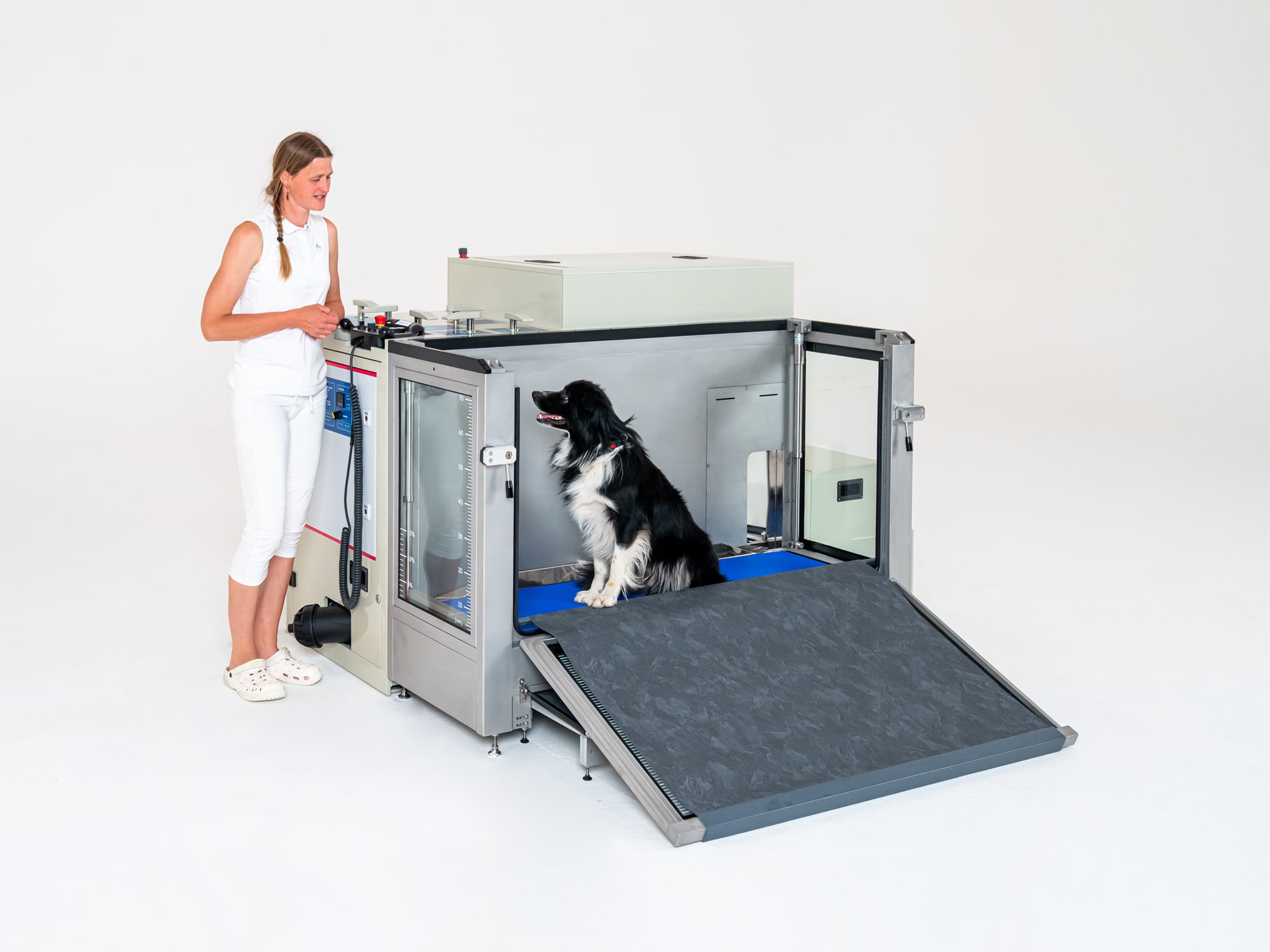
Using the hydrotherapy underwater treadmill in practice
This method of rehabilitation is based on the dog walking on the underwater treadmill while partially submerged in water. The dog is buoyed by the water, allowing it to move more easily while reducing the load on its joints. Any movements are therefore painless and the animal is motivated to move despite illness or injury. At the same time, the water resistance intensifies the strengthening of muscles that are weakened or less used.
Hydrotherapy is suitable for dogs suffering from muscular atrophy and joint and muscle pain, or for patients suffering from obesity or elderly dogs.
It is also increasingly used for sports dogs, where hydrotherapy is becoming a popular complementary tool for improving their sports training year-round.
Hydrotherapy in healthcare
Orthopaedic patients
Hydrotherapy is an ideal rehabilitation method for dogs after joint surgery and bone fractures. It is also very beneficial for dogs with hip dysplasia or dogs with arthritis.
The underwater treadmill is used to eliminate poor movement habits, which are usually associated with lameness or limb relief after surgery or injury. Walking against the resistance of the water strengthens atrophied muscles and improves the range of motion in the joints.
Neurological patients
Most often, these dogs are recovering from spinal surgery. Correct walking movements are gradually practiced with the help of the water’s buoyancy and changes to the treadmill’s speed.
Dogs that are either fully or partially paralysed due to a herniated disc or other illness tend to become accustomed to their condition and begin to overload their front legs. They must relearn to distribute their weight evenly across all four limbs, engage the pelvis and coordinate their movements. This is best done when walking in water.
Elderly dogs
Older dogs may suffer from arthrosis, spondylosis (spinal adhesions) or muscle atrophy due to their musculoskeletal system being worn down over time. Even dogs with a genetic predisposition, or dogs that have endured excessive physical stress, can suffer from these problems and may even develop these diseases much earlier. Hydrotherapy is a suitable solution to help and treat these dogs.
If a dog experiences pain during a certain movement, it tries to limit that movement. This gradually leads to muscle loss, shortening of tendons and stiffening of joints. The reluctance to move increases as the pain increases. The dog’s dose of analgesics can be increased, but this does not address the cause of their health problems.
Hydrotherapy, in conjunction with other rehabilitation techniques, mainly improves the dog’s range of motion in its joints, its muscle strength and general fitness. The life of a senior dog is thus greatly improved and often extended. Many dogs are more vital after rehabilitation and have more zest for life.
Hydrotherapy in fitness
Sports dogs
Owners of sports dogs such as greyhounds, rescue dogs, agility dogs and others often seek hydrotherapy because it is a fantastic addition to training. When dogs move in water, they engage all the muscles in their body, including those that they don’t use as much when exercising. These muscles are properly strengthened on the underwater treadmill by adjusting the treadmill speed and water level. Hydrotherapy can correct muscle imbalances and is also beneficial for the cardiovascular system.
In addition to being easy on the joints, hydrotherapy greatly improves a dog’s physical performance. Dogs that train on an underwater treadmill against the resistance of the water are then significantly more explosive in speed with better endurance on dry land. This helps sports dogs perform at their highest levels in training and competition.
Obese dogs
Hydrotherapy is also useful for dogs that are obese due to poor diet, neutering or lack of exercise. Exercising in water significantly relieves overworked joints and increases energy expenditure. The weight loss programme can be tailored to the individual dog. Depending on its physical condition, the speed and duration of walking on the underwater treadmill can be adjusted.
Postpartum female dogs can also benefit from using the underwater treadmill.
Does hydrotherapy have any limitations?
Hydrotherapy is generally suitable for all dog breeds, from the smallest to the largest, and dogs of any age. In extreme cases, however, the psychological state of the patient and the suitability of this method will need to be assessed.
For which dogs is this method not suitable?
Hydrotherapy is not suitable for dogs suffering from acute health problems (vomiting, diarrhoea, cough, fever), dogs with skin problems, open or poorly healing wounds or having recently undergone surgery, before their scars have healed. Severe cardiovascular disorders, liver or kidney failure and epilepsy can also be problematic for hydrotherapy.
Hydrotherapy is also not recommended for female dogs in heat.